
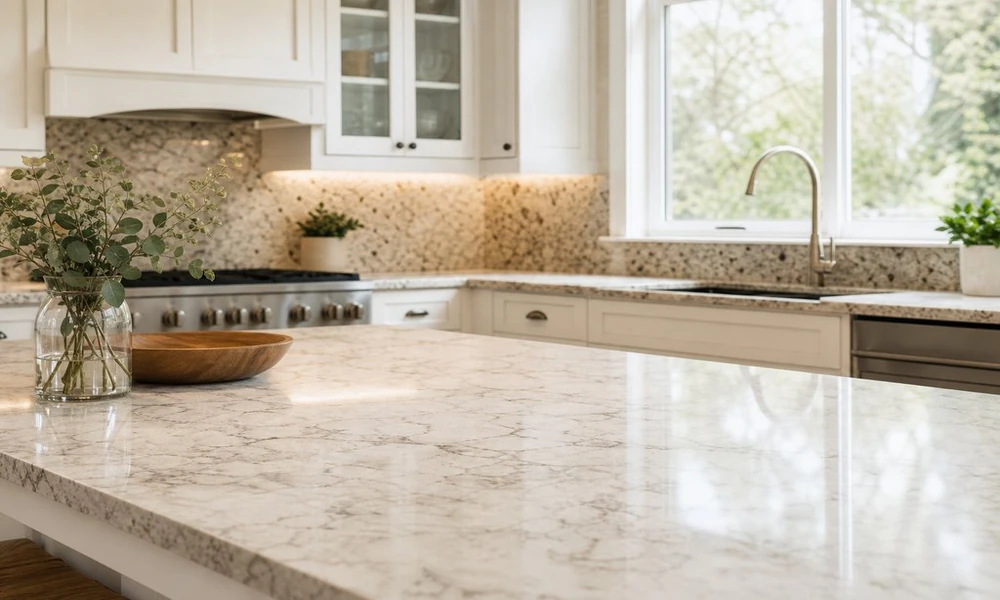

Say a Davie homeowner needs an L-shaped counter in his kitchen that measures 45 square feet. He wants it installed by the time he returns from vacation. His estimate for quartz might be $5,800, all-in. For granite, $5,150. Both estimates include the counter itself, with cut-outs for his cooktop and sink, and installation.
In a real-world example like this, quartz tends to cost more. But comparing price between quartz and granite is rarely this cut-and-dry. Many elements affect the finished price of countertops, whether they’re granite or quartz. Some have to do with the stone itself and others with the kitchen’s layout, the homeowner’s vision for his project and how complicated that makes the installation process.
To get the lowest-cost countertops in his kitchen, a Davie homeowner should know how granite and quartz are priced and which elements affect the cost of his project. He should get quotes for both stones and compare them in terms of materials and installation. That way, he’ll be able to choose the countertops that make sense for his budget and his kitchen renovation goals, whether it’s preparing his Davie house for resale, refreshing his rental between tenants or indulging a personal vision for a kitchen that’ll last for years.
Start With the Full Project Scope
Receive free quotes from local companies that install countertops.
The biggest element that affects the cost of quartz or granite is the material itself. Granite comes in a range of styles, colors – britannica.com/science/granite is worth a skim, prices, etc., just as quartz does.
For granite, widely-available stones that don’t feature lots of movement are the least-expensive options. Rare colors, patterns, lots of veining, etc., cost more. With quartz, certain colors and styles cost more than others. Thickness may affect quartz’s price, as might subtle veining.
Other elements of the project can affect quartz’s cost in ways that don’t affect granite’s price and vice versa. A few examples:
- Quartz can be engineered to look extremely consistent. That consistency is easier to achieve with bold patterns than with veining that requires attention to placement, particularly when there’s more than one piece and the homeowner wants the veining to match at the seam. Granite, by contrast, is entirely unique. Bold movement can be more costly.
Itemized Estimates Reveal the Installation Costs
The best way to understand how price works with granite and quartz is to imagine an itemized quote. It would include:
- the material itself, priced by the square foot. Granite and quartz slabs come in tiers of color, finish, rarity, thickness, etc. More expensive slabs cost more by the square foot.
- templating, which happens after cabinets go in place so that the fabricator knows where everything should be. This is an on-site visit that accounts for any quirks or special circumstances. It ensures that the countertop will fit perfectly when it’s delivered.
- edge treatments. Polished edges are standard and least-expensive, whether the homeowner chooses granite or quartz. More ornate edges cost more. Built-up edges can dramatically increase the cost of quartz or granite countertops.
- any special circumstances like a waterfall edge on an island. These can cost more and require extra attention during fabrication.
- cut-outs for cooktops, faucets, soap dispensers, filtered-water faucets and any other elements that make the project more involved. Undermount sinks require polished edges around the sink cut-out. Farmhouse sinks require a shaped edge in the front. Each of these costs a little more.
- the number of seams. With an L-shaped counter, seams are inevitable. Their location depends on the slab and how the homeowner wants them to fall in terms of pattern or movement.
- the size of the backsplash piece, assuming it’s stone. A full-height backsplash made of the same material as the countertop costs more than a standard four-inch backsplash. Full-height backsplashes require more material and more labor, especially if it entails cutting around electrical outlets.
- removing existing countertops. Some companies include this in their estimates; others charge extra.
Skip This If You Are Comparing Slab Prices AloneIn some cases, the lowest-priced granite or quartz material is the most affordable finished product. But not always. The cheapest slab is rarely the cheapest countertop installed. Homeowners should ask their installer about minimum charges. A 28-square-foot galley counter isn’t going to cost half as much as a 56-square-foot counter because of minimum charges and the fact that the installer might have to purchase an entire slab.Once the homeowner has their estimate(s), they’ll see what’s included. Removing existing counters, installing the sink, and adding a stone backsplash may be included in the estimate by some companies and itemized separately by others. Getting two or more quotes allows a homeowner to compare apples to apples and get a clearer understanding of how quartz and granite compare on price in Davie. Looking beyond the material price to installation, minimum charges, and additional services can make it easier to compare the true cost of each countertop option.Match the Countertop to the Project
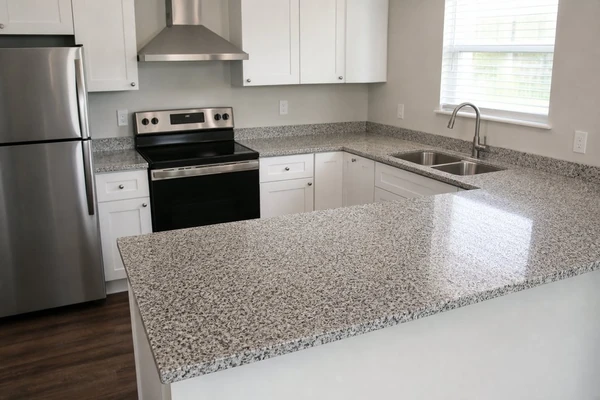
When a Davie homeowner updates his rental between tenants, he’ll choose granite or quartz that stands up to use but doesn’t cost a fortune. Basic, durable granite makes sense. Or he might go with quartz because it doesn’t vary from slab to slab and doesn’t require sealing. Either way, he’d choose a slab that doesn’t cost a fortune, a basic edge treatment and a kitchen layout that minimizes seams and complicated cut-outs.
Likewise, a homeowner updating his kitchen for resale will look for countertops that won’t break the bank. Neutral quartz might be the way to go, since it’s consistent from slab to slab and presents uniformly in listing photos. Granite is perfectly acceptable, of course, as long as the homeowner finds a slab that matches his vision for his kitchen’s finished look.
With a kitchen renovation he plans to enjoy for years to come, a homeowner can afford to go outside his usual budget to get exactly what he wants. He can choose quartz because it offers consistent patterning he likes. Or granite because he loves the way the veining looks on a particular slab. Either way, he’ll go with the option that pleases his eye.
Allow Room for Fabrication and Installation
Depending on his reason for replacing countertops in his kitchen, the Davie homeowner might have to get them done by a particular date. Preparing a house for sale or getting it ready for a new tenant limits the amount of control a homeowner has. His schedule depends on his installer’s schedule. The sooner he starts, the more wiggle room he’ll have.
