

Most property owners assume that a fire door is simply a heavier door, and that any solid entrance will do the same job. The difference is that a fire door has been burnt in a furnace as a complete assembly and shown to hold back flame for a stated period, and every unit sold afterwards must match that specimen. Anyone considering a boon woh fire rated door singapore option should understand what that certification covers, where such a door is required, and what can quietly undo it.
Where Fire Doors Are Required
Fire doors are placed wherever the building design depends on a wall to contain a fire. In residential blocks this commonly includes flat entrances that open onto a shared corridor or lobby, doors to protected staircases and doors to service risers and utility rooms. Commercial buildings add compartment walls, kitchens and plant spaces. The owner of a single unit is usually responsible for the entrance door, which is why this is the door most often replaced, and most often replaced wrongly.
What a Rating Actually Measures
The rating is a time, most commonly half an hour or one hour for doors in flats and offices. It describes how long the tested assembly kept its integrity, and where required its insulation, under a standard furnace curve. It does not mean the door is indestructible, and it does not transfer to a different frame or a different arrangement of hardware. A half-hour door fitted in an opening that requires one hour is a non-compliance, however sturdy it feels.
Reading the Label
Every certified door leaf carries a label, normally on the hinge edge or the top edge, issued under a product listing scheme run by an accredited certification body. It identifies the manufacturer, the fire rating and a reference that can be traced back to the certificate. Check that the label is present before the door is hung, and do not allow it to be planed off, painted over or removed during renovation. An unlabelled leaf cannot be shown to be a fire door at all.
Timber Construction and Appearance
Entrance doors in homes are almost always timber rather than steel, because timber can be finished to suit the interior. The fire performance comes from a dense engineered core, hardwood lipping and seals that swell under heat, with veneer, laminate or paint applied on top. Owners who care about how the door looks should read up on timber fire rated door singapore options before choosing, since grooves, mouldings and glazed panels are only acceptable where the certified design allows them.
Replacing an Existing Door in a Flat
Replacement is where problems begin. Renovation contractors sometimes fit an attractive solid door with no rating, or keep the old frame and hang a new leaf that was never tested with it. In public housing, the housing authority’s renovation guidelines state which flats need a fire-rated entrance door, and the requirement depends on the block layout. Confirm this before ordering. If the frame is being kept, ask the supplier whether the new leaf is certified for use with it.
Frames, Gaps and Seals
The gap between the leaf and frame matters more than most people expect. Too wide, and smoke and flame pass before the seals can act. Too tight, and the door binds in humid weather and stops closing fully. Intumescent strips, set into the leaf edge or the frame, expand when heated to close the gap. They must be continuous and undamaged. A door that has been trimmed at the bottom to clear new flooring may have lost more than the certification allows.
Closers, Hinges and Locks
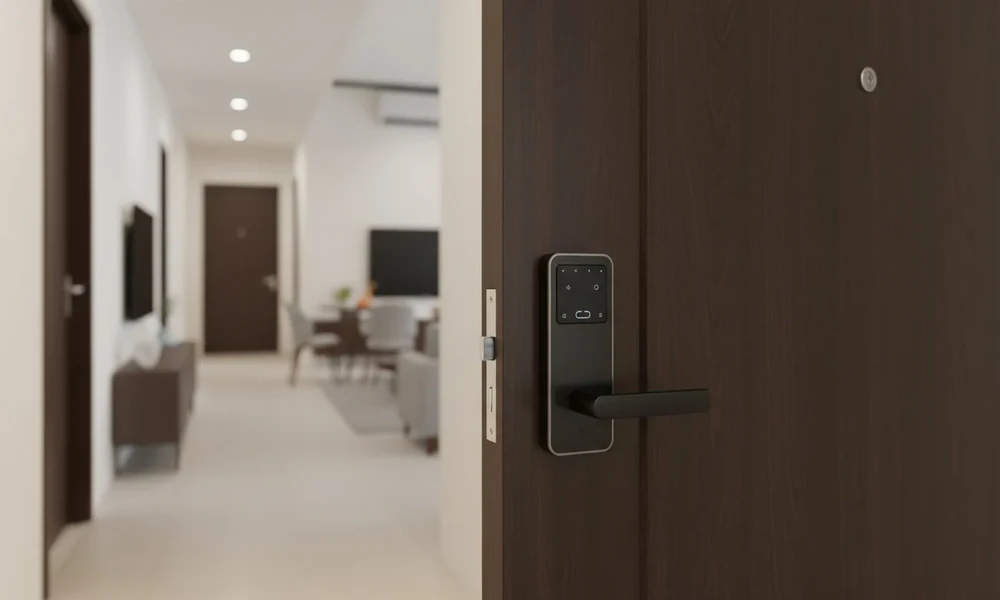
A fire door that stands open offers no protection. Where the code requires it, the door must have a self-closing device that shuts and latches it from any position. Hinges must be of the type and number tested with the leaf. Locks deserve particular care: digital locksets are popular, but fitting one means cutting a large pocket into the door. Use a model that the manufacturer has confirmed as compatible, and have it fitted according to the manufacturer’s instructions.
What Owners Must Not Alter
Several common changes cancel the rating. These include cutting a cat flap or letter slot, adding an unlisted viewer or glass panel, removing the closer because the door feels heavy, and overcladding the leaf with thick decorative panels. Repainting is generally acceptable, provided seals and labels are masked. When in doubt, ask the manufacturer before doing the work rather than after. Reinstating compliance usually means replacing the leaf, which costs far more than the alteration saved.
Sourcing and Ordering
Order from a source that can supply the leaf, frame and hardware as a certified set, provide the certificate for that exact model, and install or supervise the fitting. Measure the structural opening rather than the old door, and state which way the door swings. Guidance on what to expect from a fire rated door supplier singapore is worth reading at this stage, because the quality of documentation and fitting varies far more between suppliers than the doors themselves do.
Deciding What to Order
Begin with the rating the opening requires, then confirm whether the frame is to be replaced or retained. Choose the finish from options within the certified range, settle the lock before manufacture, and insist on a labelled leaf with a current certificate. Have the door installed by people who fit fire doors routinely. After handover, check once or twice a year that it closes and latches unaided. A compliant door that is maintained will protect the household for decades.
