
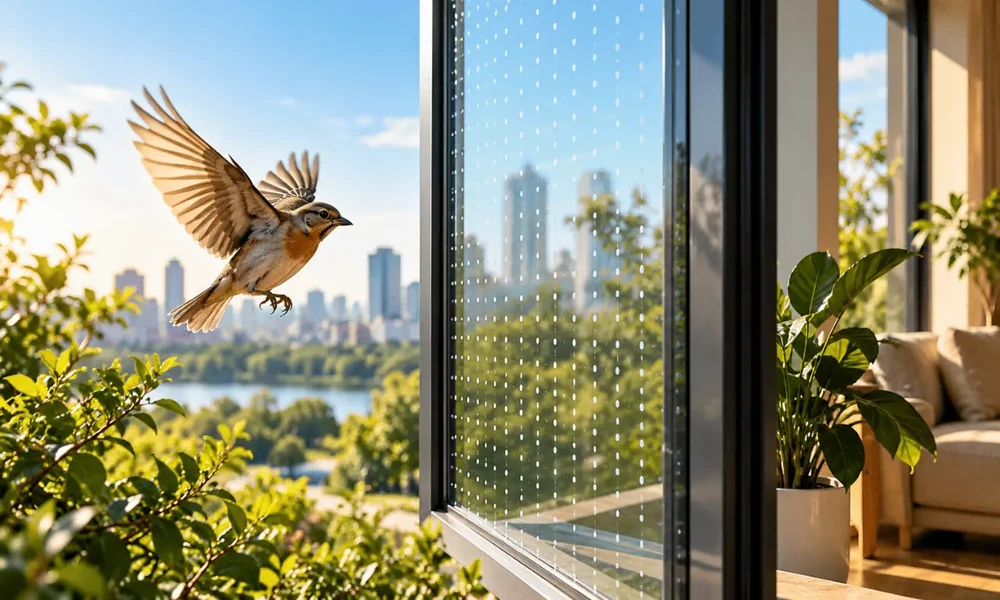

If birds are striking a window you also want to tint, keep both objectives in the project. A film selected for an indoor sunlight problem is not automatically evidence of a suitable bird-collision treatment. Look at the affected glass from outside, consult the official guidance and ask how any proposed changes will work together on that particular window.
Look at the window from the bird’s side
A homeowner may first notice the problem from a favourite chair: a sudden impact, a mark on the glass or a bird outside the window. The room is also too bright, so changing the window’s appearance can feel like one promising answer to everything. Before selecting a product, record which pane is involved and look at what that pane presents from a safe position outside.
Describe what you can actually see. Does the glass show a reflection of the garden? Can you see through the room towards another window? Are several panes involved, or has attention centred on one particular location? Photographs can help explain the setting to an appropriate adviser, but they are observations of the property, not a technical test of a product’s effectiveness.
Environment and Climate Change Canada’s bird-collision guidance explains that glass can appear to birds as a route through reflected or visible habitat. It also notes that dark glass can look like an opening. Simply deciding that the finished window will be darker therefore leaves the collision question unanswered.
Keep the assessment at ground level where possible. An upper-storey window, a glazed roof or an awkward exterior location may need professional access and advice. Do not climb or reach beyond a safe position to obtain a better photograph. Explain the limitation to the person assessing the glass; they can decide how to obtain the information needed without turning an observation into a risky household task.
A darker room does not settle the collision problem
Write the indoor concern in its own words. Perhaps strong sunlight reaches a desk, a seat becomes uncomfortable at a certain hour or a room needs a different balance of light and privacy. That is a legitimate reason to discuss solar-control film. It should not be made to carry an additional bird-related claim simply because the two concerns involve the same pane.
Ask anyone proposing a bird-collision treatment what specifically makes the glass recognisable as a barrier. ECCC’s guidance discusses regularly spaced exterior markers covering the window and explains why one or two isolated silhouettes leave gaps. Use the official guidance to evaluate the proposed design instead of treating an attractive bird-shaped sticker as a complete plan for a large area of glass.
A sample viewed from inside answers only part of the buying question. You may like the room’s appearance while still needing to establish the exterior treatment’s purpose and suitability. Keep the two judgements distinct when reviewing a proposal. An improved indoor view is valuable, but it should not be recorded as evidence that the collision concern has been resolved.
If a product is described as doing both jobs, ask for the supporting information for that exact product and installation. Have the provider explain its proposed application and how it relates to the actual glazing. Avoid borrowing a claim made for another material or a different arrangement. An answer about a product family may still leave the proposed installation unclear.
Coordinate changes on the same pane without merging their purposes
If you have chosen SRS Tints’ solar-film work for a west-facing desk window in Vaughan, keep that order focused on the indoor sunlight objective. Arrange a distinct review of the exterior bird-visible pattern for that very pane. Give both providers the proposed work before approving installation, so the household’s comfort choice does not silently become its entire collision response.
Explain any existing treatment on the window and what another provider has proposed. If one person is discussing an interior film and another an exterior treatment, each should know about the other’s work. Ask them to resolve the practical sequence and compatibility questions for the actual glass. Do not assume that two independently reasonable proposals automatically form a suitable combined installation.
A short project record can keep both objectives visible. Name the affected window, the indoor concern, the collision observations and the proposal associated with each. The record does not need to score products. Its role is to prevent an unresolved bird question disappearing when the owner signs off on a sample chosen mainly for the room’s appearance.
Include care and future access in the proposal. Ask who should be contacted if part of the treatment is damaged or if the window later needs repair. The owner should know which installed elements need to be preserved or assessed during other work. A window cleaner or repair contractor should not have to infer their purpose from appearance alone.
Where permission is needed to alter the window, bring both parts of the proposal to the appropriate owner or building contact. A general agreement to improve the room’s sunlight conditions may not describe an additional exterior design. Resolve the actual scope rather than rely on a broad description that different people could understand differently.
Watch the affected window after the work
Continue observing the specific window that prompted the enquiry. Keep notes of any further incidents and describe them accurately to the relevant adviser. Avoid turning a short quiet period into a guarantee, or treating one observation as proof of a technical cause. The record is useful because it keeps attention on the property rather than on an expectation created by a product label.
If the treatment changes or a section is removed during later work, revisit the plan. A repair that seems minor from inside may change what remains on the exterior. Share the original project information with the person doing the new work and ask what needs reassessment. The two objectives still belong to the same window even when different people maintain it.
Evaluate the room on its own terms too: whether the selected film suits the indoor light problem and whether the result fits ordinary use. Keep that feedback separate from the collision observations so each provider receives an understandable account. This makes a follow-up conversation more useful than saying only that the window treatment did or did not work.
Return to the view from outside before considering the project complete. The question there is what tells a bird that the glass is a barrier. A more private-looking room may be welcome, but the exterior needs its own considered answer.
