
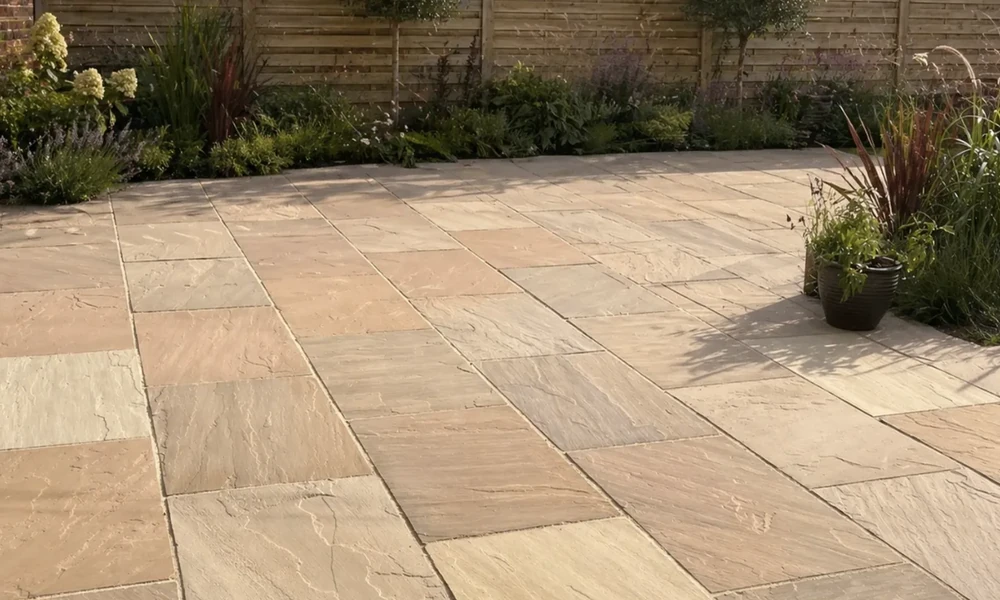

Indian sandstone can completely transform a plain patio garden into a more attractive, practical and natural-looking outdoor space. Its varied colours, riven surface and individual mineral markings give the paving a character that manufactured concrete and printed porcelain cannot fully reproduce.
The strongest patio designs do not treat paving as a separate product added at the end of the project. The stone should connect visually with the house, planting, boundary materials, garden furniture and the way the outdoor space will be used.
A well-planned Indian sandstone paving collection provides different colour options and slab formats for traditional gardens, contemporary patios, pathways, seating areas and larger landscaped spaces.
Why Indian Sandstone Can Transform a Patio Garden
Indian sandstone changes more than the colour of a patio. It introduces natural texture, tonal movement and a stronger visual connection between the garden and the surrounding landscape.
It can be used to:
- Create a defined outdoor dining or seating area
- Replace worn concrete slabs or an uneven lawn section
- Connect the house with the wider garden
- Form paths between patios, planting beds and garden buildings
- Add warmer natural tones to a plain or overly hard landscape
- Introduce texture without relying on artificial surface printing
Because sandstone is a natural sedimentary stone, no two slabs are exactly identical. Differences in colour, mineral content and riven texture are part of the material rather than manufacturing defects.
Start with the Existing Garden
Before choosing a sandstone colour, study the permanent features around the proposed patio. These features will remain in place long after furniture, pots and seasonal planting have changed.
Consider:
- The colour of the brickwork or render
- Window and door-frame finishes
- Boundary walls, fences and garden structures
- The amount of direct sunlight and shade
- The size and shape of the patio
- The style of the property
- Existing steps, paths and retaining walls
A sandstone colour that looks attractive in a product photograph may appear warmer, darker or more varied when installed beside the actual property.
Create a Contemporary Patio with Kandla Grey
Kandla Grey sandstone paving is frequently chosen for modern British gardens because its silver-grey, mid-grey and occasional blue-grey tones work well with contemporary architecture.
It can complement:
- White or pale rendered walls
- Dark aluminium doors and windows
- Grey fencing or composite screening
- Minimal planting schemes
- Black, charcoal or timber garden furniture
Kandla Grey should not be expected to produce one completely uniform shade. Some slabs may contain buff colouring, darker mineral bands or stronger variations in texture. The paving will also appear noticeably darker when wet.
This natural movement prevents a large grey patio from looking completely flat or artificial. It is particularly effective where the garden design uses simple lines but still needs some material character.
Create a Warmer Traditional Garden with Raj Green
Raj Green sandstone paving contains a mixture of olive, brown, buff, muted green and grey tones. Despite the name, it should not be understood as uniformly green paving.
Its wider colour range works naturally with:
- Red and brown brick properties
- Traditional timber fencing
- Mature shrubs and established planting
- Rustic garden furniture
- Stone walls and informal landscaping
Raj Green can make a newly constructed patio feel more connected to an established garden. Its mixed tones often soften the transition between hard paving, planting beds and older brickwork.
For traditional properties, this can be more visually appropriate than a highly uniform paving product with a manufactured finish.
Use the Patio Layout to Change the Character of the Garden
The same sandstone colour can produce very different results depending on the slab format and laying pattern.
Large Rectangular Slabs
Large rectangular sandstone slabs can make a patio feel cleaner and more directional. They are often suitable for medium and large gardens where fewer visible joints are preferred.
A running bond layout can guide the eye across the garden, but the slabs should be set out carefully to avoid narrow cuts along buildings, steps or boundaries.
Square Slabs
Square sandstone slabs can create a balanced grid and work well in compact courtyards or formal patio areas.
However, long uninterrupted joints and slight alignment errors are more visible in a square layout. Accurate setting out is therefore essential.
Mixed-Size Patio Packs
Mixed-size packs create a more traditional pattern and can make a patio feel less rigid. They are particularly suitable for period houses, cottage-style gardens and informal planting schemes.
The pattern should be planned rather than assembled randomly. Avoid:
- Four slab corners meeting at one point
- Long continuous joints
- Repeated clusters of the same slab size
- Very small cut pieces at the perimeter
- Sudden changes in joint width
Use Sandstone to Define Different Garden Zones
Indian sandstone does not have to cover the entire garden. It can be used strategically to organise the outdoor space.
For example, the paving can define:
- A dining area beside the house
- A separate seating area in a sunnier part of the garden
- A path leading to a shed, office or summerhouse
- A barbecue or outdoor kitchen area
- A transition between the lawn and planted borders
Using one sandstone colour across connected areas helps create continuity. Different slab sizes or laying directions can then distinguish individual zones without introducing too many competing materials.
Balance the Paving with Planting
A sandstone patio usually looks more integrated when planting softens its edges. Borders, raised beds, pots and ground-cover planting can reduce the visual hardness of a large paved area.
Cool grey paving such as Kandla Grey works well with architectural planting, ornamental grasses and controlled green foliage. Warmer paving such as Raj Green works naturally with mixed borders, mature shrubs and traditional planting.
The paving should support the garden design rather than dominate it. In smaller gardens, covering every available surface with stone may make the space feel harder and more enclosed.
Consider How the Stone Looks in Wet and Dry Conditions
Indian sandstone changes appearance according to weather and moisture. Dry slabs generally look lighter, while wet slabs become darker and show stronger mineral contrast.
This is particularly important in a British garden, where the patio may be viewed in wet conditions for a significant part of the year.
Before making the final selection, consider:
- The dry summer appearance
- The darker wet appearance
- Morning and afternoon shade
- The colour beside the actual brickwork
- The effect of nearby trees and planting
Blend the Slabs During Installation
Natural sandstone should not be laid one crate at a time without checking the overall colour distribution. Slabs should be selected from several crates and blended across the patio.
This helps prevent:
- One colour becoming concentrated in a single area
- Strongly textured slabs forming an obvious cluster
- A visible tonal division between different crates
- The finished patio appearing patchy or unbalanced
The installer should also inspect the slabs before laying and position stronger markings where they contribute positively to the overall design.
Plan the Practical Details Before Installation
A successful patio transformation depends on the construction beneath the paving as much as the appearance of the sandstone itself.
- The finished patio level
- The direction of drainage
- The required falls away from the building
- The position of damp-proof courses and air bricks
- The sub-base and full mortar-bed specification
- The joint width and pointing material
- Delivery access and crate storage
- Waste removal and cutting areas
Good stone cannot compensate for poor drainage, weak foundations or inadequate installation.
Allow for Cutting, Selection and Future Repairs
The ordered quantity should normally include an allowance above the measured area. Additional material may be required for perimeter cuts, pattern selection, accidental damage and future repairs.
The precise allowance depends on the patio shape, slab format and complexity of the layout. A simple rectangular patio generally creates less waste than a garden with curves, multiple steps, drainage channels and narrow sections.
Final Advice
Indian sandstone can transform a British patio garden by adding natural colour, texture and a stronger connection between the house and the landscape.
Kandla Grey is generally better suited to cleaner contemporary designs, while Raj Green provides a warmer and more traditional appearance. Neither product should be judged from a single slab because natural variation is one of the defining characteristics of sandstone.
The best result comes from combining the right colour with a suitable slab format, a properly planned pattern, balanced planting and technically correct installation. When these elements are considered together, the patio becomes an integrated part of the garden rather than simply a paved surface.
